How knitwear is built: gauge, ply, and why it matters
Published Oct 13, 2026 · Updated Oct 15, 2026 · By Iris, Pieces & materials editor
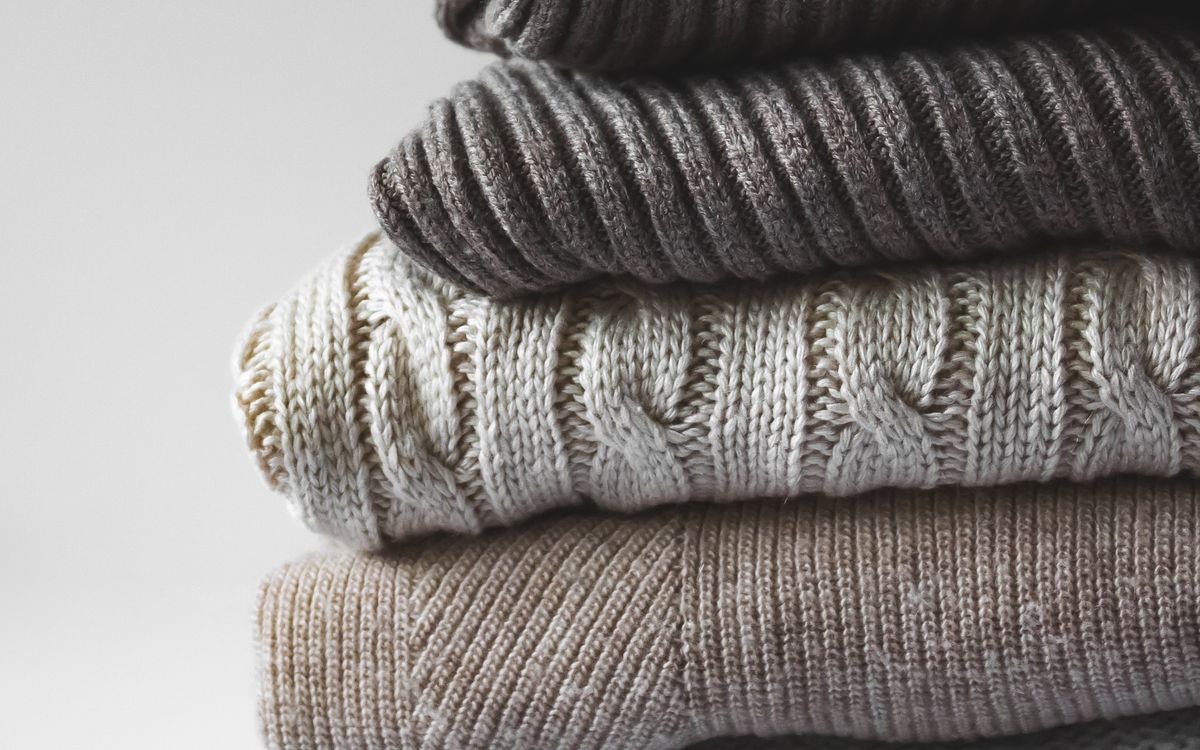
Two sweaters in the same wool can behave nothing alike, and the difference is almost never the fiber. It’s the structure: how fine the needles, how the yarn was spun, and whether the panels were knitted to shape or cut from a tube. Three words explain most of it.
Gauge is the skeleton
Gauge (written as gg, for the knitting machine’s needle count) is stitches per inch, and it tells you the weight class before anything else. Fine gauges run 12gg and up: dense, smooth, thin enough to sit under a shirt. Mid gauges, roughly 7gg to 10gg, are the everyday crewneck range. Chunky gauges, 3gg to 5gg, are the cable-and-texture territory, heavy and sculptural.
Gauge is not quality. It’s thickness. A 14gg fine knit made from short-staple yarn will pill into fuzz while a well-made 5gg lasts decades. What gauge does tell you is what the sweater can be: a fine-gauge knit holds a smooth line and layers cleanly, and a chunky gauge can’t — the texture reads casual no matter the wool.
Ply is about yarn, not layers
A 2-ply or 4-ply label counts the strands twisted together to make the yarn. It is not four layers of fabric. More strands produce a rounder, denser, more even yarn, and the twist locks short fibers in place — which is why multi-ply yarns resist pilling better than single plies at the same weight.
The number only means something next to the gauge. Four-ply at 12gg is a dense, fine, long-wearing knit. Four-ply at 3gg would be an unusually heavy chunky. When two sweaters feel different in the hand despite the same fiber, ply and gauge interacting is usually why.
Full-fashioned vs tubular
Full-fashioned knitwear is knitted to the shape of each panel (front, back, each sleeve), then linked together stitch by stitch. Nothing is cut to shape, the seams sit flat, and the panels hold their form because the loops were formed where they’ll be worn. It’s the traditional method, associated with the Scottish mills, and it’s why a full-fashioned sweater seems to keep its silhouette after years of wear.
Tubular knitwear is knitted as a continuous cylinder and then cut. It’s faster and cheaper, and it’s what most machine-made bulk sweaters are. The cost shows up at the seams (cut edges sewn rather than linked) and in how the body relaxes out of shape over time. Tubular is not automatically bad; it’s the difference between a sweater that drapes and one that holds a line.
The details worth checking
- Ribs at the cuffs and hem. Tension here decides whether the sweater still fits in year three. The rib should spring back when you stretch it, and the knitting should be tight enough that you can’t see through it.
- Shoulder construction. A saddle shoulder, a knitted band across the top, resists stretching and is the strongest choice for heavier knits. Raglan and set-in seams are fine; they just behave differently under a coat.
- Seam linking. Turn the sweater inside out. Linked seams connect loop to loop; a chain of overlocking stitches is a sewn seam on cut fabric.
- Gauge consistency. Run a hand across the body. A change in stitch size mid-panel is a tension fault, and it will pucker after washing.
Fiber gets the marketing. Construction decides the sweater. Read gauge and ply together, then look at the seams — that combination predicts wear better than any price tag.
Frequently asked questions
- Does a higher gauge mean better quality?
- No — gauge describes the weight class, not the quality. A 14gg fine-gauge knit and a 5gg chunky can both be well or badly made. Yarn quality, knitting tension, and finishing are what separate them.
- Is a 4-ply sweater warmer than a 2-ply?
- Usually, but not because of the number alone. At the same gauge, a 4-ply yarn is denser and heavier than a 2-ply, so the fabric insulates more. Compare gauges first — a chunky 2-ply can outweigh a fine 4-ply.
- Why do sweater cuffs and hems go baggy?
- Rib loses recovery with age and with stretching while wet. Wash knitwear cool, and always dry it flat — a wet rib hanging from a line will keep its stretch long after the sweater is dry.