The scarf guide: size, knit, and how it's worn
Published Oct 14, 2026 · Updated Oct 16, 2026 · By Iris, Pieces & materials editor
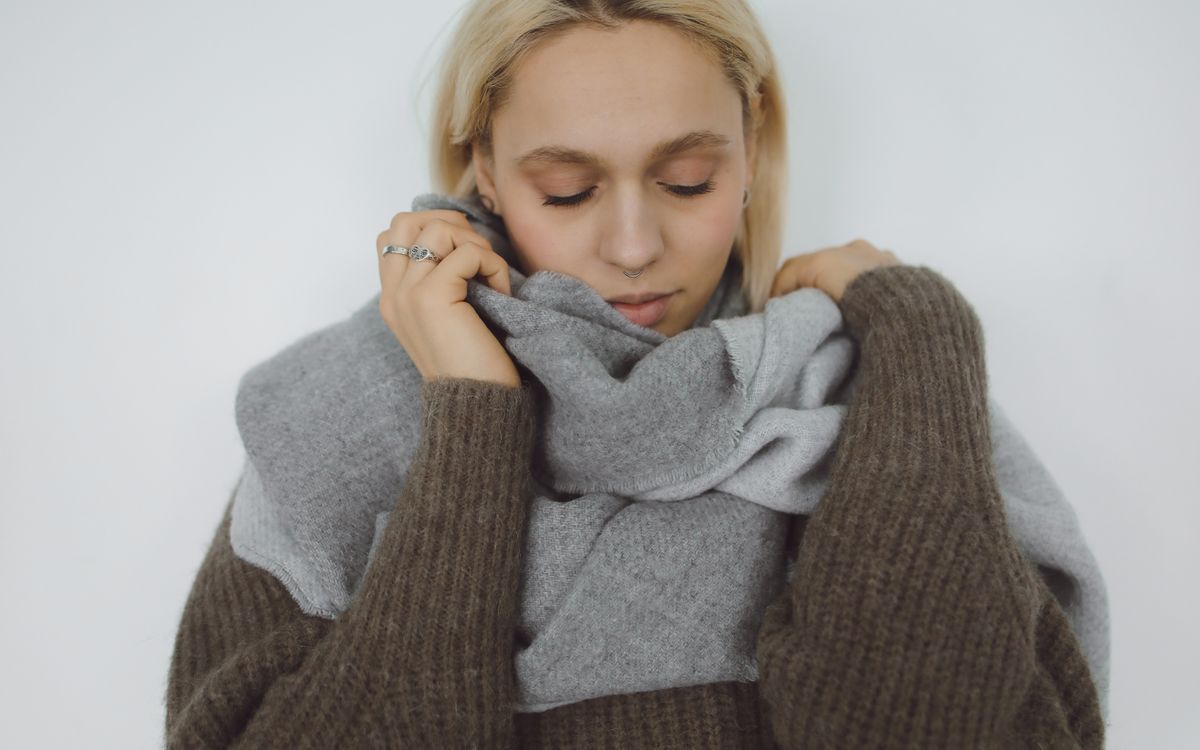
A scarf is the only accessory that’s also insulation. It earns its place in the scenes with a cold interval (the walk to the venue, the hour on the rooftop, the ride home), and it can be worn a dozen ways depending on its size and construction. The way to choose one is backward from how it’s sold: start with the scene and the coat, then pick the size and knit that work inside them.
Size decides how it’s worn
Size isn’t a style choice; it’s a functional one. The standard scarf, the 60-inch-by-12-inch neighborhood, ties in every knot from the loop to the overhand and layers cleanly under a coat. A square scarf, roughly 22 to 26 inches, folds into a triangle and ties at the neck or over the shoulders; it’s lighter and reads dressier. An oversized blanket scarf (70 inches and up, wide enough to be a wrap) is really a travel and outdoor piece: it bulges under a jacket and swallows a tailored coat.
The rule of thumb: the bulkier the layer it has to live inside, the smaller the scarf. Under a structured wool coat, a standard size or a square; over everything, the blanket scarf.
Knit vs woven
Construction changes behavior more than pattern does.
- Knit (ribbed, jersey, cable) has stretch and loft. It’s warm for its weight, forgiving around the neck, and it’s what you want when the scene is genuinely cold. The trade is bulk: a chunky knit adds a pillow at the collar.
- Woven (twill, herringbone, satin) has no stretch and drapes flat. It reads neater under a coat collar and shows pattern cleanly, but it’s less warm per ounce, and cut edges need a hem or they fray.
For most cold-weather scenes, a fine-gauge knit is the answer: enough loft to insulate, not enough to fight the coat. Chunky cable knits are for scenes where the scarf is the outer layer.
Material behavior
- Wool insulates when damp, resists odor, and is the default for cold scenes. Merino specifically is fine enough to sit against the skin.
- Cashmere is warmer and lighter than wool at the same thickness, and markedly less durable — it pills, and it wants hand-washing. It’s the dress-scene fiber.
- Cotton is breathable and light: the answer for windy-but-not-freezing scenes and for the shoulder seasons.
- Blends (wool-acrylic, wool-silk) trade some of the above for price and washability. Read the label for the ratio; past about 20% acrylic the drape starts to change.
One or two
One. A scarf is already the accessory doing the work at the neck; a second piece at the same height reads as costume rather than as warmth. If the scene is colder than one scarf can handle, the answer is a heavier single scarf or a coat with a proper collar, not a stack.
Choosing for the scene
Our read: own two. A fine-gauge neutral knit in wool for the cold-weather everyday, and one lighter piece, woven cotton or a wool-silk blend, for the shoulder seasons. Neutrals work at every formality level; a patterned scarf does more work and needs a quieter outfit around it.
The one-finish rule still applies: if the scarf is the accessory, skip the statement watch. Two pieces at equal weight is one too many — the point we made in The quiet accessories that finish an evening look.
Frequently asked questions
- What size scarf works for most outfits?
- A standard scarf in the 60-by-12-inch range ties cleanly and layers under a coat. Oversized blanket scarves are wraps rather than scarves — they're for travel days and outdoor scenes, and they bulk under a jacket.
- Knit or woven — which is better?
- Knit scarves have stretch and loft: warm and forgiving, but they add bulk at the neck. Woven scarves drape flat and read neater under a coat collar. For genuinely cold scenes, knit; for a cleaner line, woven.
- Can I wear two scarves at once?
- One is the working answer. A scarf is already the accessory doing the work at the neck, and a second piece at the same height reads as costume. If it's cold, the better move is a heavier single scarf, not a stack.